Starting a kitchen garden with kids is one of the best things I have ever done as a mom — and I say that as someone who once killed a cactus.
A cactus. A plant specifically designed to survive neglect. I managed to overwater it, which apparently is a thing you can do, and I watched it slowly turn to mush over the course of three weeks while telling myself it was just going through a phase.
So when I tell you that you can absolutely start a kitchen garden with your kids, I mean it. If I can grow food, genuinely anyone can.
Here’s everything I wish someone had told me before I started.
Why Start a Kitchen Garden with Kids?
Before we get into the how, let me make the case for the why — because honestly it goes way beyond just growing tomatoes.
Kids who grow food eat more vegetables. This is not a theory. This is something I have witnessed with my own eyes, in my own kitchen, with a child who previously treated broccoli like a personal insult.
She grew it herself. She ate it. She asked for more.
Beyond that, gardening teaches kids patience — planting a seed and waiting. It teaches responsibility — you have to water it! And it gives them a kind of quiet pride that’s hard to manufacture any other way. For a former teacher, this is basically a free outdoor classroom.
And honestly? It gives you something to do together that isn’t a screen. That alone is worth a lot.
Start Here: The Golden Rules of Beginner Gardening
Rule 1 — Start small. Embarrassingly small.
One raised bed. Four containers on a patio. A single pot of herbs on a windowsill. Starting small is not giving up — it’s strategy.
Every gardener I know who burned out did it by planting way too much in year one and then drowning in zucchini and guilt by August.
Rule 2 — Pick plants that want to succeed
Some plants are forgiving, fast, and dramatic enough to keep kids engaged. Others are finicky, slow, and will break your child’s heart in May.
Start with these:
Cherry tomatoes — fast, prolific, eat straight off the vine Sunflowers — grow visibly fast, dramatic, kids love them Radishes — ready in 25 days, instant gratification Zucchini — almost aggressively easy, you’ll have more than you need Herbs like basil, mint and chives — small containers, fast, useful in cooking Beans — kids love watching them climb Strawberries — need I explain?
Skip for now: Carrots — slow, fussy about soil depth Watermelon — needs a lot of space Broccoli — takes patience and specific timing Corn — needs more space than you think
Rule 3 — Involve them in every step
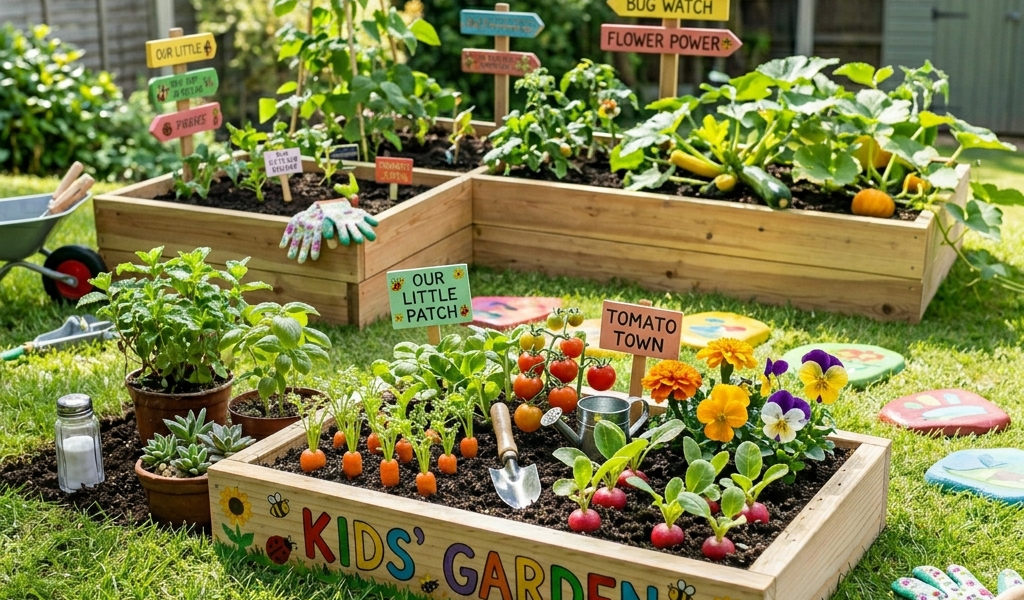
Don’t just hand kids the watering can. Let them choose what to plant, help fill containers with soil, plant the seeds themselves, make the little garden markers, and check for growth every morning. Make it a ritual.
The ownership is the whole point.
What You Actually Need
The essentials: Containers or a small raised bed — even a 4×4 raised bed is plenty to start Good potting mix — don’t use regular garden soil in containers, it compacts Seeds or starter plants — starter plants are more forgiving for beginners, seeds are cheaper and more fun for kids A watering can kids can use — lightweight, small, theirs
Nice to have: Garden gloves in their size A little notebook to record what they planted and when Plant markers — popsicle sticks work perfectly
Making It a Routine Without It Feeling Like a Chore
The secret to keeping kids interested all season is to make it a ritual, not a task.
We do garden check every morning before school. It takes four minutes. My daughter runs out, looks for new growth, checks if anything needs water, and reports back like she’s a field scientist.
Some ideas to make it stick:
Garden journal — a simple notebook where they draw what they see or write down what grew Garden discoveries — make a big deal of every milestone. First sprout! First flower! First tomato! Celebrate it. Let them cook what they grow — the garden-to-table connection is the payoff. When they pick the tomatoes, they help make the sauce. It completes the loop.
A Simple First Kitchen Garden with Kids Plan
If I were starting over here’s exactly what I’d plant:
4 containers or one 4×4 raised bed: Cherry tomato plant — one plant per large pot Fresh herbs — basil and chives in one container Bush beans — direct sow seeds ,Sunflowers — along the back or fence
That’s it. Simple, manageable, and you’ll actually harvest things.
One Last Thing
You will lose plants. Something will get eaten by something. There will be a day in July when everything looks scraggly and you wonder why you started.
That is normal. That is gardening.
Push through to the first tomato you eat still warm from the vine, standing in your backyard with dirt on your hands, and you’ll understand why people do this every single year.
It’s worth it. I promise.
If you want to grow your own food and cook with it check out my garden-to-table recipes for busy moms — they use exactly what you’ll be growing this season!